In most cleanroom SOPs, the mat at the door earns a single line: "step on mat before entry." Yet that strip of contamination control flooring does several separate jobs, and each only works if the process around it supports it. Here are ten, with the mechanism behind each.
Particle capture: what happens underfoot and under wheel
1. Stripping particulate from footwear
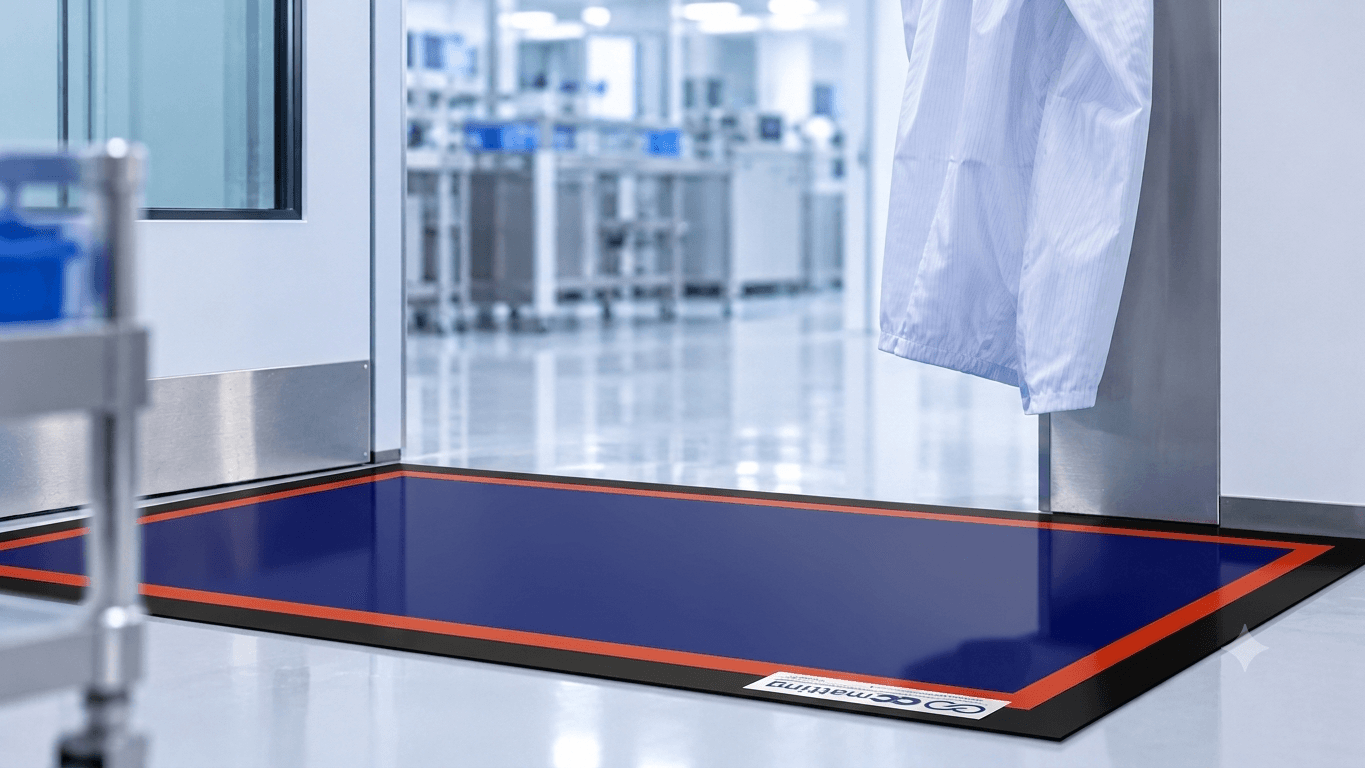
Shoe soles collect particles and fibres in corridors and goods-in areas, then deposit them at every threshold. Contamination control mats work by contact: the polymer surface lifts loose particulate from the tread. The CCM Heavy Duty mat is designed to remove particulate from soiled shoe soles as personnel walk across it, before that material is carried further into the facility. Footwear contamination control still relies on gowning; the mat handles what reaches the floor.
2. Cleaning trolley and cart wheels
Wheels cannot take an extra step. In the same study, plastic trolley wheels rolled across 90 cm of matting showed 90.1% removal of particles above 5 µm and 100% removal of particles and fibres above 100 µm.
3. Covering every step, not just the first
A fixed-size pad at a door often receives one step per foot. Because contamination control mats work by contact, the number of steps taken on the mat matters. Polymeric contamination control mats come on 2.0 m-wide rolls with no fixed length, so they can run wall to wall across an airlock. Size cleanroom entrance mats to the traffic path, including enough length for several wheel rotations.
4. Not adding particles of their own
Floor coverings are abraded by traffic. Behind searches for “ISO Class 5 mats” sits a real question: will the mat material itself shed particles as it wears? The CCM material is suitable for use in ISO Class 5 environments. That suitability applies to the material, not the room. Whether a room meets its classification still depends on the facility as a whole.
Material properties that protect people, products and processes
5. Limiting microbial persistence on the surface
The CCM material has Biomaster antimicrobial technology built into the polymer. This supports disinfection rather than replacing it; healthcare contamination control mats still need a defined cleaning frequency.
6. Dissipating static
In semiconductor, electronics and data centre environments, a charged floor attracts particles and creates ESD risk. The CCM mat material is static dissipative, which makes it relevant where electrostatic charge is a concern.
7. Keeping outgassing low near sensitive product
Volatiles from flooring can condense on optics, wafers and coatings. The CCM material is low-outgassing under normal operating conditions, which is relevant wherever sensitive surfaces are exposed.
8. Reducing slip risk in wet transition zones
Airlocks and gowning areas are often damp from disinfection. The CCM material is slip resistant in both dry and wet conditions, which matters in spaces where floors are regularly cleaned and disinfected.
Process jobs: why reusable cleanroom matting changes the routine
9. Turning surface renewal into a cleaning routine: the sticky mat alternative
Traditional tacky mats renew their surface by peeling a sheet. Washable cleanroom mats are cleaned in place, moving effectiveness into the cleaning SOP. That trade-off is what sites weigh when assessing a tacky mat alternative.
- Surface renewal
Tacky / sticky mat: Peel and discard the top sheet.
Polymeric contamination control mat: Clean in place.
- Performance driver
Tacky / sticky mat: Depends on peel frequency and tackiness.
Polymeric contamination control mat: Depends on cleaning frequency and mat length.
- Consumable waste
Tacky / sticky mat: Generates used sheets after each peel.
Polymeric contamination control mat: Replaced at the end of its service life (3–5 years, as per technical data).
- Coverage
Tacky / sticky mat: Available in fixed pad sizes.
Polymeric contamination control mat: Can be cut to the required length from a roll.
When cleaning, note that the material safety data sheet lists acetones and abrasive agents as materials to avoid.
10. Giving the contamination control strategy a measurable threshold
EU GMP Annex 1 (2022) requires sterile manufacturers to implement a facility-wide contamination control strategy. A mat at a defined zone interface, with supporting product documentation, cleaning frequency and replacement criteria, gives QA something to reference and audit. It does not demonstrate compliance on its own.
Where contamination control polymeric matting fits
Place mats where pathways cross zones: airlocks, goods-in, data hall entrances. Pharmaceutical contamination control mats work best alongside zoning, gowning and monitoring, not instead of them. CC Matting manufactures reusable contamination control matting in Cork, installs across Ireland and the UK, and supplies further afield through its distributor network; test reports are collected in its Quality & Efficacy Manual.
Frequently asked questions
Can polymeric contamination control mats replace tacky mats?
At many entry points, yes. The decision depends on traffic volume, wheeled movement, cleaning resources and how your contamination control strategy defines the threshold. Trialling one interface with before-and-after monitoring is a practical test.
How long should a cleanroom entrance mat be?
Long enough for several contacts per foot and multiple full rotations of every wheel crossing it. Laying contamination control matting wall to wall stops people stepping around it.
Does an ISO Class 5 rated mat make my cleanroom ISO Class 5?
No. An ISO Class 5 suitability rating means the material's particle emission under mechanical stress was tested and found within ISO Class 5 limits. Room classification depends on airflow, filtration, people and processes.
How are washable contamination control mats cleaned?
For CCM matting, the efficacy study used 70% isopropyl alcohol with lint-free cleanroom wipers, and the safety data sheet advises avoiding acetones and abrasive agents.
How do I choose a contamination control mat supplier?
Ask for independent test reports covering particle removal, particle emission, ESD behaviour and slip resistance, with the test method and conditions stated. Check installation support, warranty, and whether a contamination control mat distributor covers your region.
Next step
Mapping floor-level pathways for your contamination control strategy? The CC Matting compliance page sets out the test standards behind the data above. To discuss a specific interface, contact the CC Matting team.